ppALIGN API documentation
freescore.cpp
This example shows the usage of the BoltzmannWeight to produce the plot
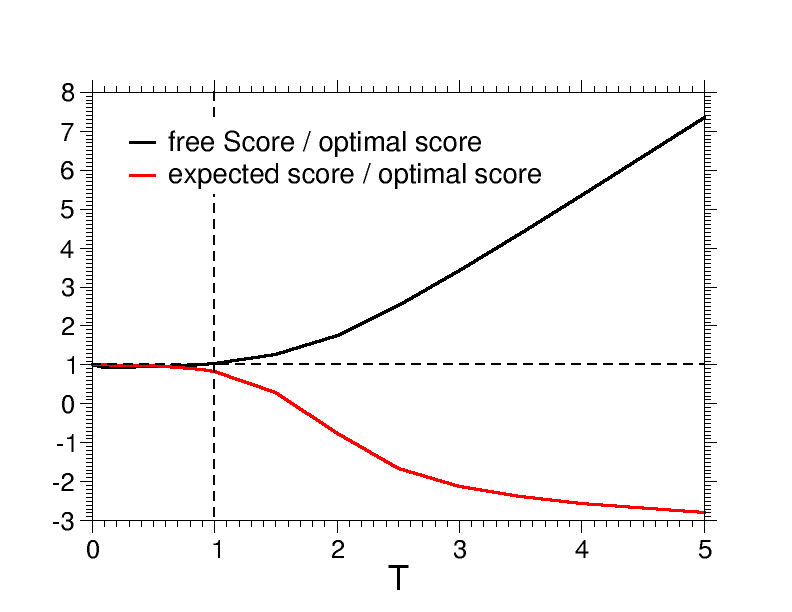
//  Computation of the free and expected score
//  for the finite temperature model
//
// There are two methods:

#include <partitionworkspace.hpp>
#include <weights.hpp>
#include <firstmoment.hpp>
#include <viterbi.hpp>


using namespace std;

int main()
{
  // the sequences
  ProteinSequence seq1("MTLWMHLLPLLPQLPLWGSNLAPEFAEQQGCFSHLNRTVELDVEVEYELCGERT");
  ProteinSequence seq2("MELWVRLLPLAPQLALYGPEFIDQHTSIVEALAAYCGGHLGRAICSNLEVEVLYEVCEGRS");

  // alignment parameters
  double temperatures[] = { 0.1, 0.2, 0.3, 0.4, 0.5,
                            0.6, 0.7, 0.8, 0.9, 1.0,
                            1.5, 2.0, 2.5, 3.0, 3.5,
                            4.0, 5.0, 6.0, 7.0, 8.0 };
  int    n_temper       = 20;
  string matrix_name    = "blosum62";
  double matrix_scale   = 2.0/log(2.0); // the scale of the blosum matrix
                                        // only needed when we using the
                                        // integer valued matrix
  int    gap_open       = 11;
  int    gap_extension  = 1;
  bool   allow_DI       = true;
  bool   allow_ID       = false;

  // use the integer valued matrix as a basis
  // this is closer to the optimal alignment based
  // on the integer score matrix, but there might be
  // some rounding errors
  // if we use this option we may expect that
  // the free_score -> optimal score for small temperatures.
  bool   use_int_matrix = true;

  // the score matrix
  ScoreMatrix score_matrix(proteinAlphabet,proteinAlphabet,matrix_name);

  // the workspace objects
  PartitionWorkspace pws(10000);
  ViterbiWorkspace   vws(10000);


  // compute optimal score
  int score = vws.OptimalScore(seq1,
                               seq2,
                               score_matrix,
                               LocalBounded,
                               gap_open,
                               gap_extension,
                               allow_ID,
                               allow_DI);
  cout << "#optimal score: " << score << endl;
  // the scale of the blosum
  // only needed when we using the
  // integer valued matrix
  // estimate lambda from sequence and compare with
  // sequence composition:
  Frequencies freq(proteinAlphabet);
  freq.Count(seq1);
  freq.Count(seq2);
  freq.Normalize();
  double a = exp(0.0);

  double lambda_est = score_matrix.GetScale(freq,freq);
  double lambda     = ScoreMatrix::GetScale(proteinAlphabet,
                                            proteinAlphabet,
                                            matrix_name);
  cout << "#sequence  lambda: " << lambda_est << endl;
  cout << "#blosum    lambda: " << lambda << endl;

  // the driver for the first moment
  cout << "#temperature free_score/opt_score expected_score/opt_score" << endl;
  DriverFirstMoment  first_moment(score_matrix,gap_open,gap_extension);
  for(int i = 0; i < n_temper; i++)
    {
      BoltzmannWeight  * weight;
      double temper;
      // weights for the finite temperature model
      if(use_int_matrix)
        {
          // the canoical temperature is equal to the matrix_scale
          temper = temperatures[i]*matrix_scale;
          weight = new BoltzmannWeight(score_matrix,
                                       temper,
                                       gap_open,
                                       gap_extension,
                                       LocalBounded,
                                       allow_DI,
                                       allow_ID);
        }
      else
        {
          // here, the canonical temperature is 1
          temper = temperatures[i];
          weight = new BoltzmannWeight(proteinAlphabet,
                                       proteinAlphabet,
                                       matrix_name,
                                       temper,
                                       gap_open,
                                       gap_extension,
                                       LocalBounded,
                                       allow_DI,
                                       allow_ID);
        }
      xdouble Z;
      double  free_score,expected_score;
      // add driver and perform the computation
      pws.AddDriver(first_moment);
      Z = pws.PartitionFunction(seq1,
                                seq2,
                                *weight);
      // compute free score
      free_score = log(Z) * temper * weight->scale;

      // expected score
      expected_score = first_moment.FirstMoment();

      cout << temperatures[i] << "\t"
           << free_score/score << "\t"
           << expected_score/score << endl;
      delete weight;
    }
  return 0;
}